Interview with Annie Mackin, Summer Exhibition at Tillingham
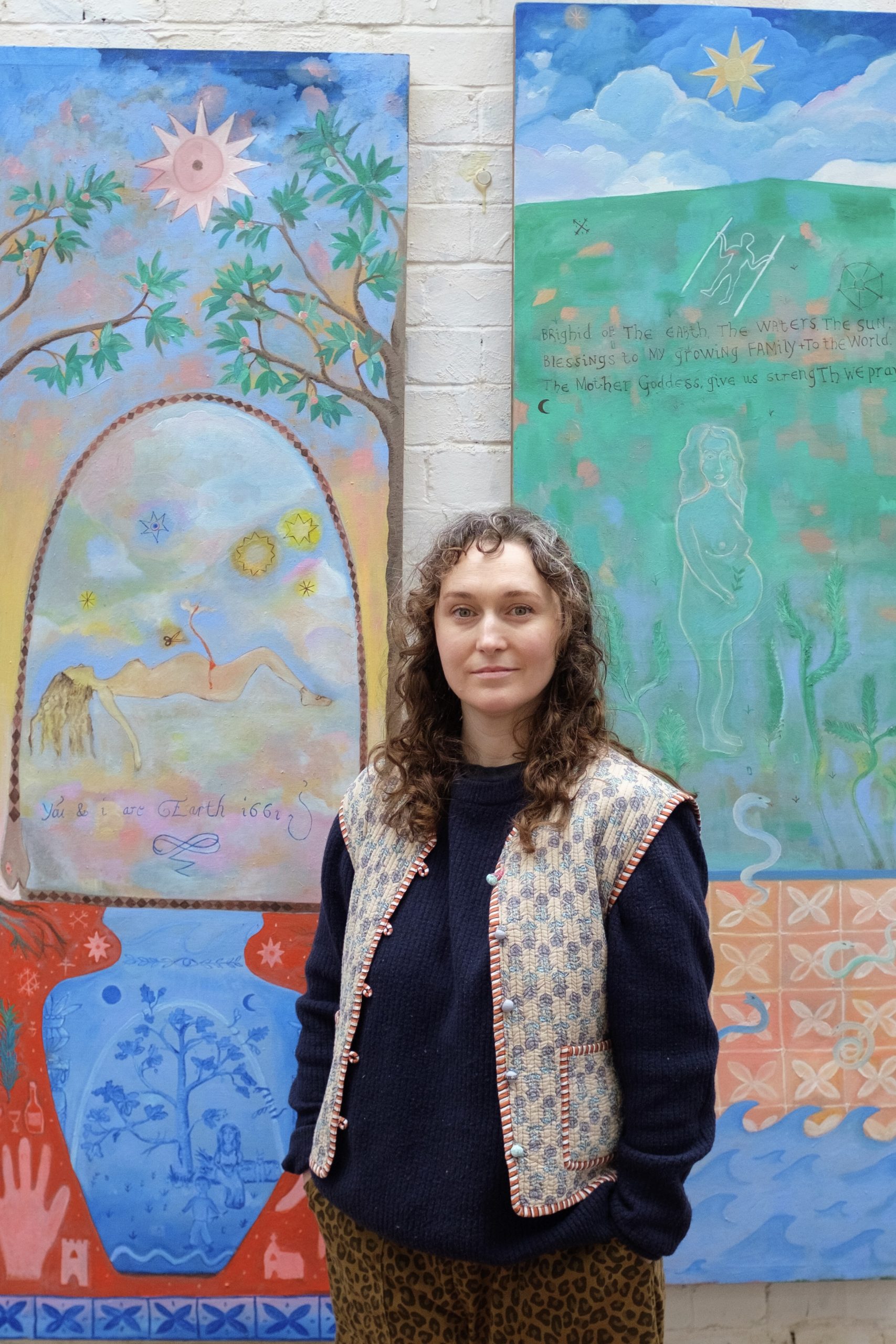
VINUM LAETIFICAT COR HOMINUM —“Wine Makes Glad the Heart of People”.
An exhibition of paintings at Tillingham by Annie Mackin. We interviewed Annie to discover the stories, landscapes and memories woven through her paintings, and what it means to show her work at Tillingham.
Your exhibition is titled VINUM LAETIFICAT COR HOMINUM “Wine Makes Glad the Heart of People”. What does this phrase mean to you, and why did it feel like the right title for this exhibition at Tillingham? I liked that it’s a popular medieval saying and is still applicable today, not only that but works
perfectly within the setting of Tillingham. I did however swap the word man for people!
Your work often brings together landscape, folklore, memory and mythology. What was the starting point for this particular exhibition at Tillingham? I wanted this exhibition to be a celebration of how my paintings, full of individual stories, can come together to communicate a larger message. Although full of medieval allegory and folklore, memory, loss, life and ancestry connects my works, and I hope add to the idea of coming together within the setting of Tillingham.
Tillingham is such a distinctive place, surrounded by the East Sussex landscape. How has the setting influenced the work you’ve chosen for the show? It’s so fitting to me to show at Tillingham as it is based in the heart of East Sussex where a lot of my inspiration comes from, I think all of my work has at least one connection to the landscape.
There’s a strong sense of history and ancient storytelling within your paintings. What draws you to myths, legends and stories that have been passed down through generations? Coming from an Irish and Scottish working class family that lived in London there was a lack of stories growing up so I think I’m trying to recapture something from the past that got lost in the struggle of today’s society.
Your paintings often have an ethereal, almost dreamlike quality. How do you create that atmosphere through your use of colour, light and oil paint? My painting style is very instinctual and I don’t think I could paint the same thing twice! I work alot in pastel colours which I think create the light and dreamlike aesthetic well but I’m trying to ground them more in earth tones at the moment. I’m intrigued in the juxtaposition of balancing
ethereal with something more earthy.
You’ve spoken about memory, grief and nostalgia in relation to your work. Do you see painting as a way of preserving memories, or perhaps transforming them into something new?
I think of them as a way to work through grief and try to create something positive out of loss and trauma. I think that’s why the light and more pastel tones can create a sense of hope even if the subject matter is darker or melancholic.
Nature and the changing seasons appear to be important threads within your practice. What does the East Sussex landscape give you creatively that you might not find elsewhere?
I think the beautiful landscape, intertwined with the folklore and traditions is very special and magical. Its so beautiful and green and surrounded by the sea and such joyful celebrations that mark different times of the year, like Jack in the green or summer solstice celebrations to the bonfire societies making there way around different towns and villages.
There are often references to ancient rituals, sacred places and pagan traditions in your work. What is it about these older ways of understanding our relationship with nature that continues to resonate with you? I think initially I was rebelling against organised religion and Catholicism in particular, the religion
I was brought up in, and perhaps I needed some sort of ritual to replace what I had known. But now I see it as an extension of celebrating the changing seasons as well as honouring ourselves and our place on the earth.
Women, goddesses and female figures from history and mythology feature strongly in your paintings. What do these women represent to you, and has your relationship with these figures changed over time? I think the celebration of women of any kind is so important in today’s society, but when I became a mother, celebrating what it means to have a baby and be a caregiver felt so natural. But within that, finding goddesses about the nurture and comfort of mothers felt comforting. Since having another baby 6 years later, I’m again finding comfort within these figures.
Some of your paintings seem to exist somewhere between the real and imagined worlds. When you begin a painting, do you start with a particular story or place, or does the narrative emerge as the work develops? I sometimes have glimmers of ideas I want to paint about or I have an inspirational object I’d like to paint, sometimes I just know the colours I’d like to use. But I never draw on a canvas, I always play in paint and see what emerges, which is the beauty of oil paint, you can move it around, add and take away. It’s a much more conversational way to paint, I think. When I started painting my work was purely abstract so I think I still carry the same mindset when painting but it ends up more figurative.
How important is it for you that viewers recognise the stories and references within your paintings, as opposed to simply responding to the mood or feeling of the work? It’s not important for me that viewers understand my meaning within a painting, it’s far more interesting if they connect what I’ve painted to their own lives, Even within a painting of me and my kids.
What does exhibiting in a place like Tillingham – where art, landscape, food, wine and community come together – offer you that a traditional gallery setting might not? It’s like having a private view every day! Tillingham is such a place of celebration, I want my paintings to feel like an extension of that. It also allows the viewer to see how the work might look in their home’s surrounded by lovely furniture and food and wine.
Do you think being rooted in East Sussex has changed the way you see and make art?
Yes, moving to Hastings 10 years ago impacted every aspect of my life including my ability to have a studio space and how and what I painted.
Your work often seems to suggest that the past is still present in the landscape around us. Are there particular places in Sussex that you return to again and again for inspiration? I love to visit castles ruins and Battle abbey, especially during the reenactment. My friends have taken over the events at Hastings castle, so it’s magical to be amongst the ruins but celebrate the now. The long man of Willington features a lot in my work and I love going to the long man pub with my family. Last time we were there, there was a horse parked in the car park, if that’s
not the past blending with the present, I don’t know what is!
Is there a particular painting in this exhibition that feels especially personal to you, or that you’d like visitors to spend a little more time with? Anything I have in the the show with my children are very personal as well as the triptych in the studio based on three stages of my life through grief, pregnancy and birth. They are quite big so there’s lots of symbolism and elements to look at.
Finally, what would you hope people take away with them after seeing your work at Tillingham? I’d hope people enjoy being around my paintings and find inspiration or connect to my work. And encourage people to explore the landscape and stories of East Sussex.
The show ends 30th September 2026.